
Here are the Black horror authors you should read first, plus starter books and quick reading paths to match your mood. This guide moves from foundational voices to the writers publishing right now, with anthologies that let you sample dozens of authors in a single sitting. Start with Tananarive Due’s The Good House if you want one title to begin with tonight.
TL;DR:
- Most Black horror authors, from classics to contemporary voices, have key works available that can be sampled through anthologies and short fiction before committing to longer novels.
- Preview chapters and podcast anthologies are crucial tools for assessing tone, pacing, and fit without the risk of buying a full-length book that may not match your mood.
- Foundational works by Octavia Butler, Jewelle Gomez, and Tananarive Due span over fifty years, showcasing the genre’s deep roots in Black literary history and trauma.
- Current authors like Tonia Ransom, Sylvester Barzey, and Nnedi Okorafor are expanding the genre’s thematic range through social horror, Afrosurrealism, and regional folklore.
- Using curated anthologies and small press collections helps new readers discover diverse voices efficiently and avoid the obstacle of high upfront commitment.
Table of Contents
- Black Horror Authors Worth Reading First
- Where Black Horror Started: Six Foundational Reads
- Contemporary Voices Reshaping Black Horror Fiction
- Anthologies That Make Discovering Black Horror Easy
- Reading Paths, Themes, and How to Pick Your Next Book
- Sampling Black Horror on ThrillerHorrorSuspense.store
- What Black Horror Authors Say About Their Own Craft
- An Editorial Take on Building This List
- Start Reading Without the Guesswork
- Sources
- FAQ
Black Horror Authors Worth Reading First
Picking a starting point in this genre can feel harder than it should, mostly because so few reading lists mix the classics with what’s coming out this year. The twelve names below span pulp era storytellers, literary horror stylists, and writers who built their following through short fiction and podcasts. Each entry gives you a reason to pick up the author now and a specific book to start with.
- Tananarive Due writes horror that treats grief and generational trauma as haunted-house material. Start with The Good House, a slow-burn possession story rooted in family history.
- Octavia Butler brought body horror and dystopian dread into speculative fiction long before it was fashionable. Fledgling is her most direct horror entry, reworking vampire mythology through a genetically altered protagonist.
- Tonia Ransom built a reputation producing and writing short horror fiction for audio before print, and her work leans into folk horror and cosmic dread in equal measure. Her stories collected through NIGHTLIGHT make an easy entry point if you want fifteen-minute doses instead of a full novel.
- Sumiko Saulson writes Afrosurrealist horror that bends reality without losing narrative footing. Happiness and Other Diseases is a strong first read, blending psychological horror with satirical bite.
- Victor LaValle reworks Lovecraftian horror to confront the racism baked into the genre’s early canon. The Ballad of Black Tom is short enough to finish in an evening and sharp enough to change how you read H.P. Lovecraft afterward.
- L.A. Banks wrote fast, plot-driven vampire horror with a Black woman at the center of a war between good and evil. The Vampire Huntress Legend Series is the entry point, and it rewards readers who like long, serialized arcs.
- Chesya Burke writes horror grounded in Southern folklore and historical violence. Let’s Play White is a story collection that works as a low-commitment sampler of her range.
- Sylvester Barzey builds horror and fantasy stories that put Black protagonists at the center rather than the periphery, a deliberate choice he’s written about directly on his author site. His short fiction is a good on-ramp before tackling longer work.
- Nalo Hopkinson merges Caribbean folklore with body horror and speculative dread. Brown Girl in the Ring remains her most accessible starting point.
- Nnedi Okorafor writes horror-adjacent speculative fiction rooted in West African mythology and near-future settings. Who Fears Death is intense but rewards the commitment.
- Linda D. Addison is a poet and short story writer whose work bridges horror’s pulp roots and its literary present. Her essay on early Black horror storytellers, published through the Horror Writers Association, doubles as a reading list in itself.
- Rion Amilcar Scott writes literary horror steeped in the history of a fictional Maryland town founded by formerly enslaved people. The World Doesn’t Require You is his standout collection.
Some of these authors write doorstopper novels. Others built their reputation one short story at a time. That mix is the point: you can sample a dozen distinct voices before committing to a single 400-page book.
Where Black Horror Started: Six Foundational Reads
A foundational writer in this space usually did one of two things: they either wrote horror decades before the publishing industry had a category for it, or they built the infrastructure (magazines, small presses, community organizations) that let later writers get published at all. Linda D. Addison’s essay on early Black horror storytellers traces this lineage back further than most readers assume, showing that Black authors were writing ghost stories, folk horror, and gothic fiction well before horror became a marketed genre.
- Octavia Butler, Kindred. Not marketed as horror, but the time-travel plunge into antebellum slavery produces some of the most viscerally frightening scenes in twentieth century American fiction. Read it before anything else on this list.
- Tananarive Due, The Between. Due’s debut novel established the psychological dread and slow reveal that define her later work. It’s also a useful primer for her larger body of work, which she discusses in detail on her author site, including her role teaching Black Horror and Afrofuturism at UCLA.
- L.A. Banks, Minion. The book that launched the Vampire Huntress Legend Series and proved urban fantasy horror with a Black protagonist could sustain a long-running franchise.
- Jewelle Gomez, The Gilda Stories. A vampire novel spanning two centuries, following a Black lesbian protagonist through American history. It reframed what a vampire narrative could convey thematically.
- Chesya Burke, Let’s Play White. Southern Gothic horror grounded in real historical trauma, published by a small press that championed Black horror fiction when larger houses weren’t looking.
- Linda D. Addison, Consumed, Reduced to Beautiful Grey Ashes. The first Black woman to win a Bram Stoker Award, and this poetry collection shows why. The Horror Writers Association maintains records of award recognition that put her achievement in context.
These six books cover roughly fifty years of publishing and three distinct subgenres. Read them in order and you’ll watch the genre’s vocabulary expand in real time.
Contemporary Voices Reshaping Black Horror Fiction
The current generation of Black horror writers isn’t waiting for mainstream publishing to catch up. Several built audiences through short fiction, podcasts, and small press anthologies first, then moved into novels once readers were already paying attention.
- Tonia Ransom produces NIGHTLIGHT, a fiction podcast that has become one of the more reliable pipelines for new Black horror short stories, and she’s a World Fantasy Award winner in her own right for that work.
- Sumiko Saulson edits as much as she writes, curating anthologies that showcase Afrosurrealist and cosmic horror from emerging voices alongside her own novels.
- Sylvester Barzey writes horror and fantasy that deliberately centers Black characters, treating representation as a craft choice rather than a marketing angle.
- P. Djèlí Clark blends historical fantasy with horror elements, often set in alternate versions of American history where the supernatural intersects with racial violence.
- Eden Royce writes Southern Gothic horror rooted in Gullah Geechee folklore, a regional tradition rarely represented in mainstream horror fiction.
- Cynthia Pelayo works at the intersection of horror and true crime, using poetic structure to explore violence against women in Chicago.
The throughline across these six writers is thematic range: Afrosurrealism, social horror, and speculative horror all show up here, sometimes within a single author’s catalog. If you want a low-risk way to sample several of them at once, look for their short fiction in anthologies before committing to a novel.
Anthologies That Make Discovering Black Horror Easy
Anthologies solve a real problem: committing to a 300-page novel from an unfamiliar author is a bigger ask than reading one 20-page story. A good anthology lets you test five or six voices in an afternoon and figure out whose full-length work you actually want to buy next.
- Sycorax’s Daughters, edited by Kinitra Brooks, Linda D. Addison, and Susana Morris, gathers horror fiction and poetry exclusively from Black women writers.
- Whispers in the Dark: Ghost Stories by Black Writers, edited by Crystal M. Wilkinson, focuses on ghost and haunting narratives across generations.
- Sumiko Saulson’s editorial projects, detailed on her author page, regularly spotlight emerging Afrosurrealist and cosmic horror writers who haven’t published full novels yet.
- Dark Matter: A Century of Speculative Fiction from the African Diaspora, edited by Sheree Renée Thomas, remains one of the most cited entry points into Black speculative horror as a category.
- NIGHTLIGHT’s podcast archive, produced by Tonia Ransom, functions as an ongoing anthology of short horror fiction, updated far more frequently than any print collection could manage.
- Bram Stoker Award anthology submissions, tracked by the Horror Writers Association, offer a running record of which Black horror short fiction earned peer recognition each year.
Editors matter more than readers usually give them credit for. A curator like Saulson or Ransom is doing real editorial work deciding whose voice gets amplified next, which means following an editor can be just as useful as following an individual author.
Reading Paths, Themes, and How to Pick Your Next Book
Not every reader wants the same entry point, so match the path to what you actually have time and appetite for.
- Short stories first: Start with NIGHTLIGHT episodes or the Sycorax’s Daughters anthology if you want low commitment and fast payoff.
- Social horror: Read Victor LaValle’s The Ballad of Black Tom followed by Rion Amilcar Scott’s The World Doesn’t Require You for horror that confronts racism directly.
- Afrofuturist horror: Move from Octavia Butler’s Fledgling to Nnedi Okorafor’s Who Fears Death for speculative horror grounded in African mythology and future settings.
- Historical gothic: Pair Jewelle Gomez’s The Gilda Stories with Tananarive Due’s The Between for slow-burn dread rooted in history.
- Southern folk horror: Read Chesya Burke’s Let’s Play White alongside Eden Royce’s Gullah Geechee inspired fiction.
Before you buy anything, run a quick checklist: does the tone match what you’re in the mood for (slow dread versus fast-paced scares), is the length realistic for your schedule this month, and are there content areas you’d rather avoid. A sample chapter answers most of that in five minutes flat.
Pro Tip: Check your local library’s ebook lending system before buying anything. Many library systems, like the setup at Hayward Public Library, let you borrow ebooks for free with nothing more than a library card, which makes it painless to sample three or four authors before spending money on any of them.
Sampling Black Horror on ThrillerHorrorSuspense.store
Buying a horror ebook from an author you’ve never read is a real gamble, and it’s the exact problem preview chapters solve. This website lets you read a sample chapter before you buy, so you’re not stuck with a full-price novel that doesn’t match what you were hoping for.
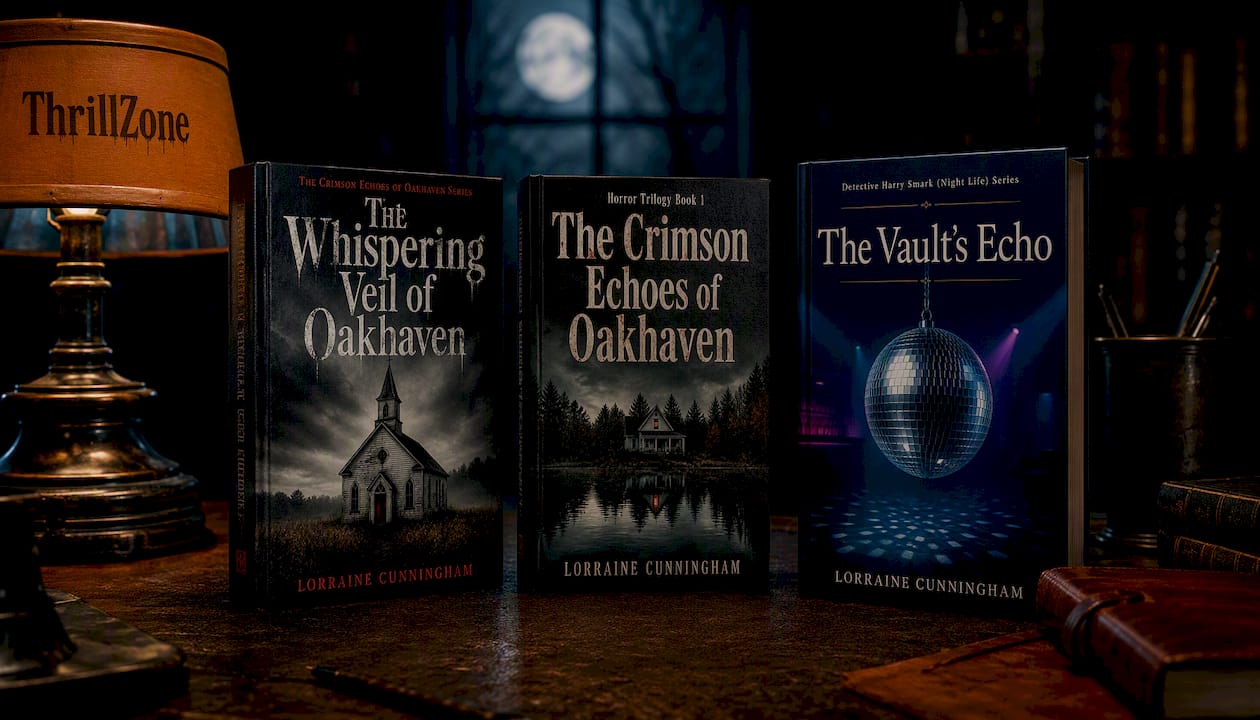
Three titles on the site work well as examples of what you’ll find browsing the catalog. The Crimson Echoes of Oakhaven opens a series and gives you a full preview chapter before you commit, making it a solid first pick if you’re new to the storyline. The Whispering Veil of Oakhaven continues that series for readers already invested in the Oakhaven mythology. And Detective Harry Smark blends horror with thriller pacing, a good pick if you want scares mixed with a procedural edge.
| Title | Best for | What to expect |
|---|---|---|
| The Crimson Echoes of Oakhaven | New readers starting a series | Series opener with preview chapter |
| The Whispering Veil of Oakhaven | Readers continuing the Oakhaven story | Direct sequel, deeper mythology |
| Detective Harry Smark | Fans of horror/thriller crossover | Procedural pacing with horror elements |
Navigating the site is straightforward: browse the Horror or Thriller categories, open a title, preview the sample chapter, and use the search filters if you’re hunting for a specific theme or tone.
What Black Horror Authors Say About Their Own Craft
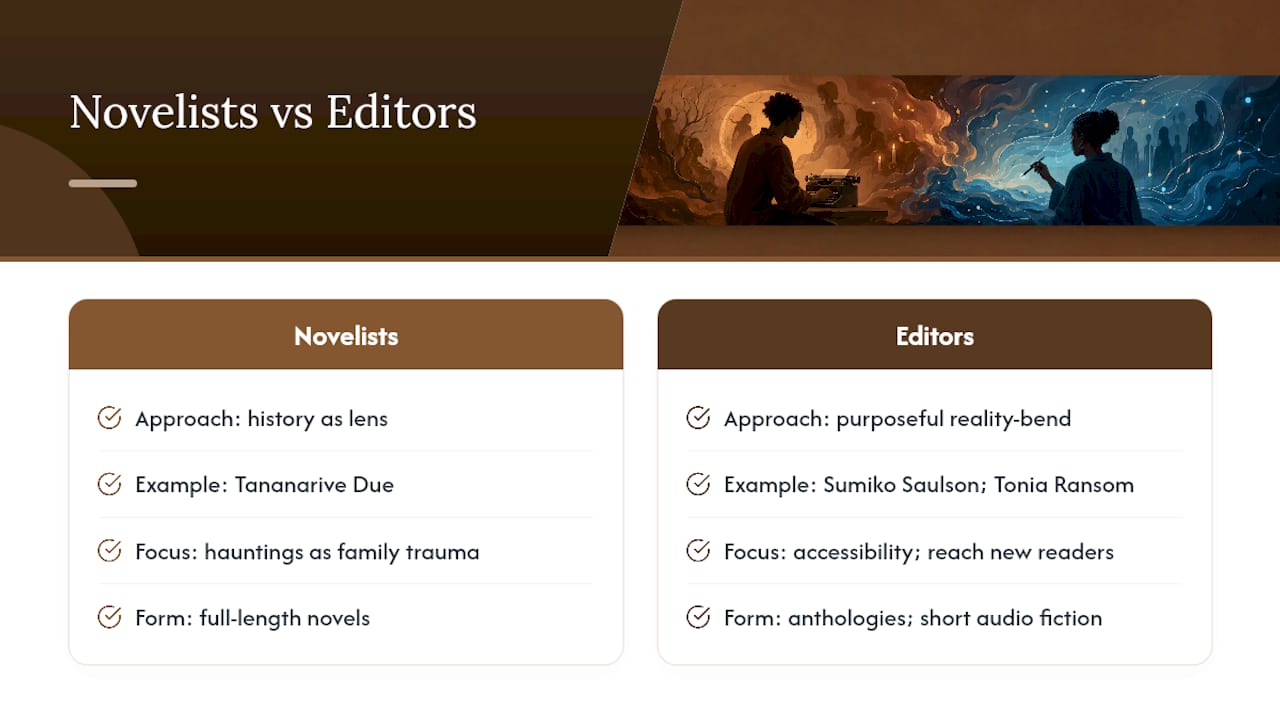
Writers in this space talk often about horror as a vehicle for history rather than an escape from it. Tananarive Due has described her approach to horror as inseparable from teaching Black Horror and Afrofuturism, treating the genre as a tool for examining generational trauma rather than pure entertainment. That framing shows up across her novels, where hauntings are rarely random. They’re tied to something a family buried and never resolved.
Editors talk about craft differently than novelists do. Sumiko Saulson has built a career split between writing Afrosurrealist fiction and curating anthologies, and that dual role shapes what she looks for in submissions: voices that bend reality in ways that feel purposeful rather than decorative. Tonia Ransom’s work producing NIGHTLIGHT reflects a similar instinct toward accessibility. Short horror fiction, delivered as audio, reaches readers who might never pick up a 300-page novel but will absorb a fifteen-minute story on a commute.
The common note across these creators isn’t fear for its own sake. It’s horror as a lens for examining what a community has survived, and what it’s still carrying.
An Editorial Take on Building This List
The instinct with most “best of” horror lists is to chase novelty, stacking the newest releases at the top and treating anything published before 2020 as homework. That approach undersells how much of the genre’s current strength was built by writers like Octavia Butler and Jewelle Gomez decades before publishers had a marketing category ready for them.
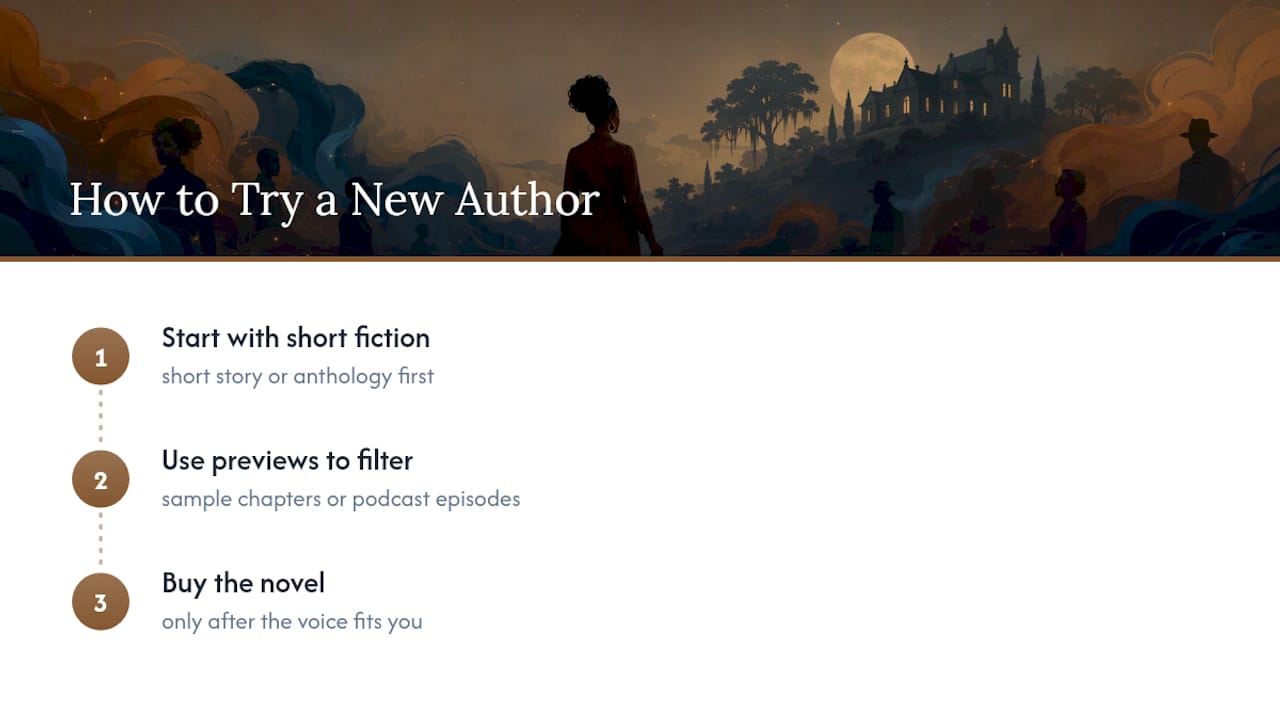
The bigger failure in most reading guides, though, is assuming every reader wants a 400-page commitment. Anthologies and short fiction podcasts do more to build a lasting readership than any single novel recommendation, because they let you fail fast on an author who isn’t for you and move on without regret. That’s also why preview chapters matter more than most retailers admit. If you can read the first chapter before paying, you’ve already solved the biggest risk in trying an unfamiliar voice.
Start with a short story. Let the anthology or the sample chapter do the filtering. Buy the novel once you already know the voice works for you.
— lorraine
Start Reading Without the Guesswork
The site is built around one idea that solves the exact problem this guide keeps coming back to: you shouldn’t have to buy a novel blind to find out if the voice works for you. Many titles, including original works, come with a preview chapter, so you can sample the pacing and tone before spending money. That matters most with horror, where tone can make or break a book in the first ten pages.
If the reading paths above pointed you toward series fiction, start with The Crimson Echoes of Oakhaven and preview the opening chapter before deciding whether to continue into The Whispering Veil of Oakhaven. Prefer horror with a procedural edge? Detective Harry Smark is worth the sample chapter. Browse the full horror catalog or check the thriller collection if you want to widen the search, and preview a chapter before you buy.
Sources
- Tananarive Due — Bio + Contact
- Genesis – The First Black Horror Writers/Storytellers by Linda D. Addison
- Tonia Ransom – Horror Writer + Award-Winning Fiction Podcaster
FAQ
Who are some notable African American paranormal fiction authors?
Tananarive Due, L.A. Banks, and Jewelle Gomez all wrote paranormal fiction centered on hauntings, vampire mythology, and supernatural family history. Due’s teaching background in Black Horror and Afrofuturism makes her novels a strong starting point for readers new to the subgenre.
Who are the top 10 horror book authors?
There’s no single agreed-upon top ten, but the most frequently cited Black horror authors include Octavia Butler, Tananarive Due, Victor LaValle, L.A. Banks, Nnedi Okorafor, Jewelle Gomez, Linda D. Addison, Chesya Burke, Nalo Hopkinson, and Sumiko Saulson. Each brings a distinct subgenre, from body horror to Afrosurrealism.
Who are some of the best Black thriller authors?
Writers blending horror and thriller pacing include authors behind titles like Detective Harry Smark, available on Thrillerhorrorsuspense, which mixes horror atmosphere with procedural plotting. Rion Amilcar Scott and Cynthia Pelayo also write horror with strong thriller and crime elements woven through.
What are the top 10 books by Black authors in horror?
A strong reading list includes Kindred by Octavia Butler, The Good House by Tananarive Due, The Ballad of Black Tom by Victor LaValle, Minion by L.A. Banks, The Gilda Stories by Jewelle Gomez, Let’s Play White by Chesya Burke, Fledgling by Octavia Butler, Brown Girl in the Ring by Nalo Hopkinson, Who Fears Death by Nnedi Okorafor, and Sycorax’s Daughters, edited by Kinitra Brooks, Linda D. Addison, and Susana Morris.
What makes anthologies a good starting point for new readers?
Anthologies let you sample multiple authors’ voices in one sitting instead of committing to a full novel from someone you’ve never read. Editors like Sumiko Saulson and Tonia Ransom, through her NIGHTLIGHT podcast, actively curate collections that spotlight emerging Black horror writers alongside established names.