
Start with the Detective Harry Smark series or A Bunch of Daisies if you want tech thrillers that earn their tension instead of faking it. Both let you preview chapters before you buy, so you can test an author’s grasp of technology and pacing without gambling on a purchase. The rest of this guide shows you exactly what to check in those preview pages before you commit.
TL;DR:
- Preview chapters reveal whether the technical language feels natural and consistently supports the story’s pacing, preventing slow or confusing reads.
- Human stakes in tech thrillers should surface early, with clear risks affecting characters, not just system failures or gadgets.
- Believable technology depends on authors with real technical backgrounds, with pacing that mimics how fast network threats actually spread.
- AI becomes a primary threat in recent thrillers by acting as an independent character rather than just a tool, reflecting current headlines.
- Genre-specific stores and preview chapters help verify tech logic and voice before purchase, ensuring the book’s credibility and matching your mood preferences.
Table of Contents
- Curated Tech Thriller eBooks Worth Sampling First
- What Makes a Great Tech Thriller Believable?
- How Do You Preview and Pick a Tech Thriller eBook?
- Which Reading Path Fits Your Tech Thriller Mood?
- How Tech Thrillers Have Changed Over the Decades
- Where to Buy and Read Tech Thriller eBooks
- What’s Trending in Tech Thriller eBooks Right Now
- How Do Tech Thrillers Differ From Other Thriller Subgenres?
- What Readers Actually Look For in a Tech Thriller
- Why We Curate These Titles Before You Buy
- Sample a Chapter Before You Commit
- Sources
- FAQ
Curated Tech Thriller eBooks Worth Sampling First
Picking a tech thriller blind is a coin flip. The genre lives or dies on whether the author actually understands the technology driving the plot, and you can’t tell that from a book cover or a two-line description. Preview chapters solve that problem, and Thrillerhorrorsuspense builds its catalog around letting you read before you spend.
Here’s where to start, based on what kind of tension you’re chasing:
-
Detective Harry Smark (Night Life Book 1) is the series opener, built for readers who want a detective grinding through tech-laced cases rather than a lone hacker saving the world. The standout is the series hook itself: Smark’s world expands book to book, so starting here sets up everything that follows. A preview chapter is available, and it’s worth reading the first two chapters specifically to see how the author handles procedural detail without slowing the plot to a crawl.
-
Detective Harry Smark (The Vault’s Echo Book 2) raises the stakes from book one and works well for readers who like a continuing mystery that layers technology into the plot rather than centering it. The escalation is the draw here: the tech elements feel like consequences of the first book’s events, not a new gimmick bolted on. Sample the opening pages and check whether the connective tissue to Book 1 feels earned or forced.
-
A Bunch of Daisies sits at the crossover between psychological suspense and tech-driven plotting, and it’s the pick for readers who want unease built from character rather than just from a ticking clock. Its unique hook is that the tension comes from what the protagonist can’t trust about their own situation, tech included. Check the preview for how quickly the psychological stakes surface. If they show up by the end of chapter one, the pacing is doing its job.
A quick buying tip across all three: read the preview carefully. If you’re still confused about what’s at stake early on, that’s a pacing problem, not a problem.
What Makes a Great Tech Thriller Believable?
A tech thriller earns its “believable” label when the technology could plausibly break the way the plot says it does. The genre, often called a techno-thriller, centers on advanced technology like AI, cyberwarfare, and networked systems driving suspenseful, high-stakes narratives, according to MasterClass. Wikipedia’s entry on the genre describes the classic setup as a race against time to stop a disaster triggered by weaponized AI, rogue code, or leaked intelligence, usually driven by a hacker, cryptographer, or former analyst.
Author expertise separates the genre’s best work from its weakest. Readers tend to trust authors with real technical backgrounds because that experience shows up in small details that are hard to fake, a differentiator MasterClass points to directly.
Pacing matters just as much as accuracy. Look for:
- Short chapters that mimic how fast networked threats actually move
- Action that jumps locations instead of stalling in one room
- Human stakes that stay front and center, not buried under exposition
Fast fact: the strongest techno-thrillers use ticking-clock structures specifically because networked threats spread at a speed slow narration can’t capture, a pacing signal worth checking in any preview chapter.
How Do You Preview and Pick a Tech Thriller eBook?
Judging a tech thriller before you buy comes down to five checks you can run in under ten minutes using a preview chapter.
- Read the first three to five pages for voice and jargon handling. If the technical language feels like a lecture, the rest of the book probably reads that way too.
- Scan for clear stakes within chapter one. You should know what’s at risk and for whom before the chapter ends.
- Note whether characters have believable tech backgrounds. A hacker who talks like a marketing executive is a warning sign.
- Test pacing through chapter length and cliffhanger endings. Short chapters that end on a hook usually signal a tighter plot.
- Check that human stakes show up early, not just system failures. The best techno-thrillers use tech to raise ethical and personal stakes, not just to show off gadgets, according to CrimeReads.
Pro Tip: Use the preview chapter to test an author’s “technical voice” rather than trusting the back-cover blurb. Blurbs sell concepts. Previews reveal whether the author can actually write the concept convincingly.
Watch for two red flags in particular: long info-dumps explaining how the technology works before anything happens, and internal tech logic that contradicts itself between chapters. Both usually mean the author sketched the concept without stress-testing it.
Which Reading Path Fits Your Tech Thriller Mood?
Tech thrillers split into a few reliable lanes, and matching your mood to the right one saves you from a mismatched read.
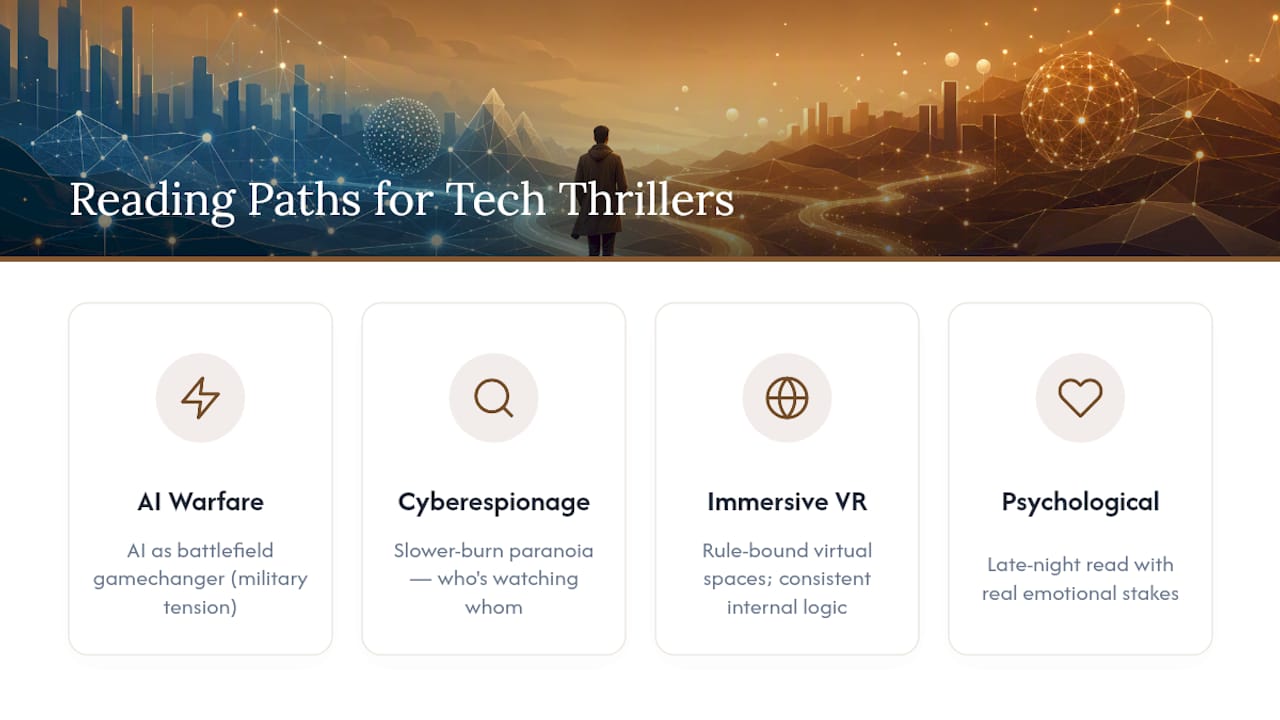
AI and weaponized tech. This lane delivers battlefield stakes where artificial intelligence is the disruptor, not just a background tool. Recent entries like Mark Greaney’s The Chaos Agent frame AI as a battlefield gamechanger in fast-paced, high-stakes plotting. If you want a late-night page-turner with military tension, this is your lane, and the Detective Harry Smark books scratch a similar itch with grounded procedural stakes instead of battlefield scale.
Cyberespionage and surveillance. Slower-burn tension, more paranoia than action, and a focus on who’s watching whom. This lane rewards patience over adrenaline, closer to a thoughtful cautionary tale than a sprint.
Immersive VR and digital-world thrillers. These books live or die on internal logic. When a virtual space follows consistent rules, it reads as real; when it doesn’t, it reads as filler exposition. Kimberly Unger’s The Extractionist is a solid example of a VR-driven techno-thriller built on that kind of consistency. If you’re drawn to digital-world stakes, look for that same rule-bound consistency in anything you sample.
For a straightforward late-night read with real emotional stakes, A Bunch of Daisies fits the psychological crossover lane better than the AI or cyberespionage tracks.
How Tech Thrillers Have Changed Over the Decades
Early techno-thrillers leaned on Cold War hardware, submarines, missile systems, and defense bureaucracies as the source of dread. The technology was often physical and national in scale: a weapon, a system, a government agency losing control of it. Dan Brown’s Digital Fortress marked a shift toward code-breaking and intelligence-agency technology as the central threat, positioning cryptography itself as the battlefield rather than a missile silo, per Dan Brown’s official site.
The genre kept moving as real technology did. By the time Daniel Suarez published Daemon, the threat wasn’t a government system at all. It was an autonomous program running independent of any single actor’s control, a widely cited example of the genre’s pivot toward decentralized, networked danger.
That pivot mattered because it changed who the villain could be. Early tech thrillers needed a nation-state or a rogue general. Modern ones can build an entire plot around code that nobody fully controls anymore, which raises stakes that feel closer to how technology actually fails today. Writers who ground plots in current headlines, drone warfare, AI advances, deepfakes, tend to hit harder because readers recognize the underlying tech from the news, not just from fiction.
The throughline across every era stays the same: the tech changes, but the human cost of losing control of it doesn’t.
Where to Buy and Read Tech Thriller eBooks
Most readers land on one of two paths: a general marketplace with everything mixed together, or a store built specifically around genre fiction. General marketplaces offer volume, but that volume means wading through unrelated categories to find the tech thrillers worth your time.
A genre-specific storefront skips that step. This storefront organizes its catalog around thriller, horror, and suspense titles exclusively, which means every browse session stays inside genres you actually want. The thriller collection groups tech-driven plots together instead of scattering them across a broader fiction catalog, and the horror collection sits right alongside it for readers who cross genres.
Another differentiator is the ability to preview a chapter before buying, something most general marketplaces don’t offer at the product-page level. That feature changes how you shop: instead of relying on star ratings or a marketing blurb, you read the author’s actual voice first. For a genre where technical credibility makes or breaks the read, that matters more than it does in most fiction categories.
Wherever you buy, check for two things: sample availability and how the store categorizes tech-driven plots specifically, rather than lumping them into a generic “thriller” bucket with no way to tell the tech-heavy books from the rest.
What’s Trending in Tech Thriller eBooks Right Now
AI as an active plot driver, not just a background detail, is the clearest shift in recent tech thrillers. Older entries treated artificial intelligence as a tool a character used. Newer ones treat it as a character in its own right, capable of acting against its creators, a shift visible in how The Chaos Agent frames AI as a battlefield disruptor rather than a support system.
Surveillance anxiety has also intensified. Plots increasingly center on who has access to your data and what they can do with it, reflecting real headlines about privacy erosion more than Cold War era paranoia about physical infiltration.
Immersive digital spaces are becoming their own subgenre rather than a side element. Books like The Extractionist treat virtual environments as fully realized settings with internal rules readers can track, a level of world-building that used to be reserved for straight science fiction.
Expect this trend to keep moving toward technology readers already worry about: generative AI, deepfakes, and autonomous systems making decisions without human sign-off. The best writers in the space aren’t inventing far-future threats anymore. They’re dramatizing this year’s headlines a few steps ahead of where they currently stand.
How Do Tech Thrillers Differ From Other Thriller Subgenres?
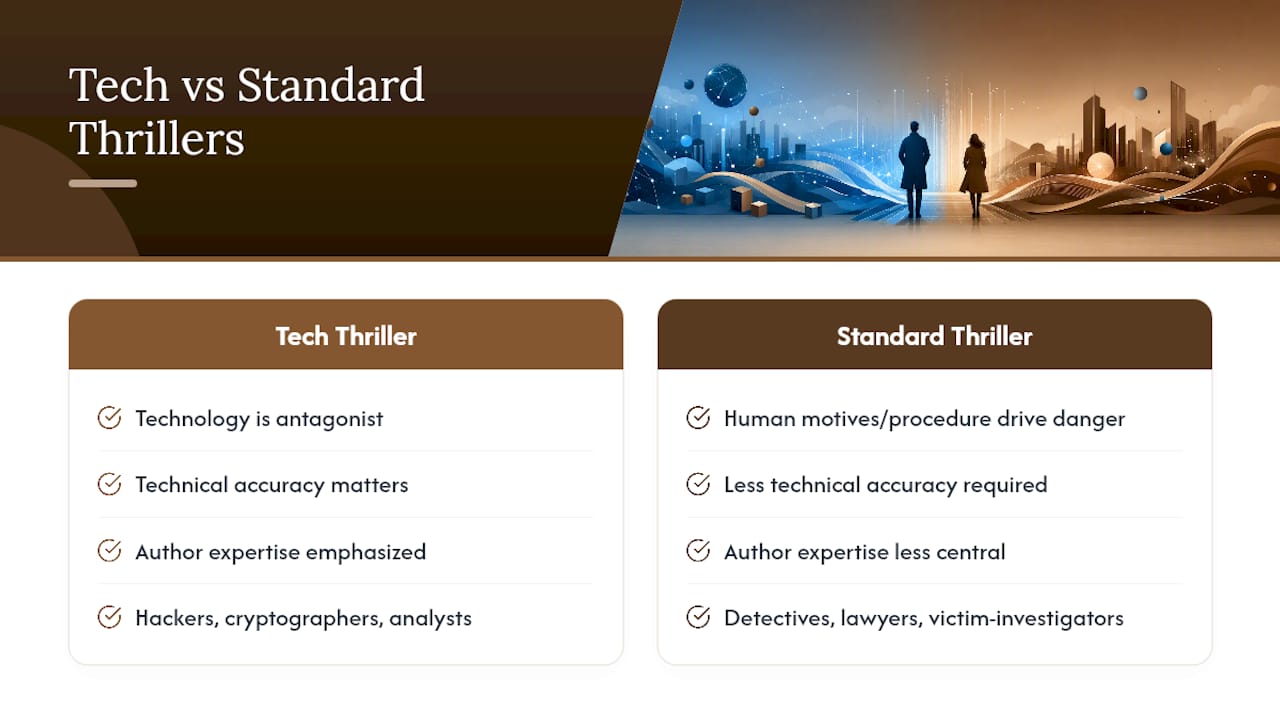
The line between a tech thriller and a standard thriller comes down to what’s driving the danger. A legal thriller runs on courtroom stakes and procedure. A psychological thriller runs on an unreliable narrator or a character’s fractured perception. A tech thriller runs on the technology itself functioning as both weapon and antagonist.
That distinction shapes the reading experience. In a tech thriller, you need the mechanism to make sense. If the hacking scene, the AI decision, or the surveillance system doesn’t hold up to basic logic, the whole plot wobbles. Thrillers built on human deception or legal maneuvering don’t carry that same burden. Nobody expects a courtroom thriller to teach you actual case law, but a strong techno-thriller earns credibility partly through getting the tech right, which is why author expertise gets flagged so often as a differentiator in MasterClass’s analysis of the genre.
Character types shift too. Standard thrillers often center detectives, lawyers, or victims turned investigators. Tech thrillers frequently reach for hackers, cryptographers, or former intelligence analysts, protagonists positioned to understand the very systems threatening to collapse, a pattern Wikipedia’s overview of the genre lays out clearly.
If you’re used to reading straight suspense or mystery, the adjustment is mainly about tolerance for technical texture. You’ll read more explanation of how something works, but the best entries fold that explanation into action instead of pausing for a lecture.
What Readers Actually Look For in a Tech Thriller
Three things decide whether a tech thriller lands: does the technology feel real, does the pacing keep moving, and does a human being stay at the center of the danger.
Technical authenticity ranks highest for a reason. Readers can forgive a slow chapter. They rarely forgive a hacking scene that makes no internal sense, or an AI system that behaves however the plot needs it to behave in the moment. That’s why author background gets mentioned so often. Writers with real technical grounding tend to build systems that behave consistently, and that consistency is what readers actually notice, even if they can’t always name why a book feels credible.
Pacing comes second, and it’s tightly linked to chapter structure. Short chapters that jump between locations mimic how fast a networked threat actually spreads, keeping tension alive without requiring constant action. A slow tech thriller isn’t necessarily a bad one, but it needs to earn that slower pace through mounting dread rather than exposition.
Human stakes decide whether a book sticks with you after you finish it. The strongest entries in the genre use technology to force ethical choices, not just to generate a countdown clock. A character forced to choose between exposing a friend’s data breach or protecting them resonates longer than a generic “stop the hackers” plot, because the tech becomes a mirror for a human decision instead of just a threat to defuse.
Why We Curate These Titles Before You Buy
Choosing what goes into this catalog means reading past the premise to check whether the tech logic holds and whether the human stakes actually land. That’s the bar for every title we feature, including the Detective Harry Smark series and A Bunch of Daisies. This storefront specializes specifically in digital thriller, horror, and suspense titles, and many product pages include a preview chapter to test tech logic before purchasing. Read a sample first. If the voice grabs you in the first few pages, that’s usually a reliable sign the rest of the book will hold up.
— lorraine
Sample a Chapter Before You Commit
Some e-book stores skip this feature entirely: a way to read before you buy, so you’re never gambling on jargon-heavy prose or a hacking scene that falls apart under scrutiny.
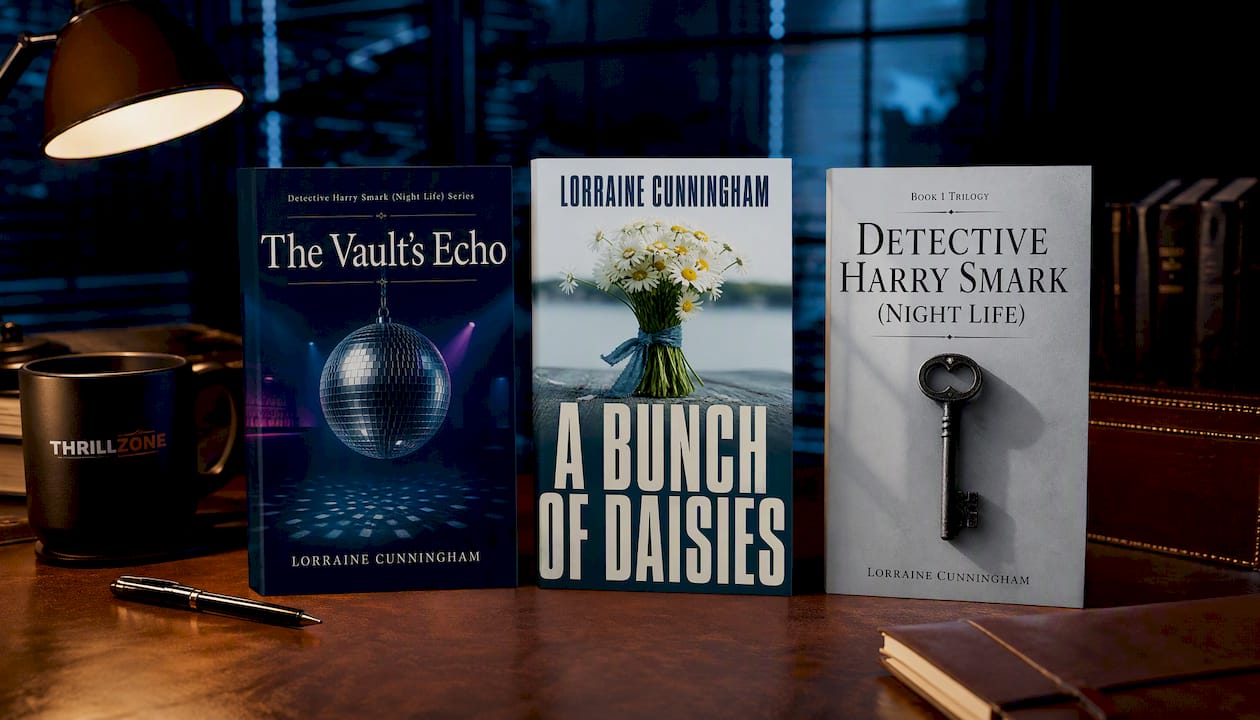
Start with the Detective Harry Smark series opener if you want a grounded, procedural entry point, or head to the full e-book collection to browse everything from tech-driven suspense to straight horror. Every product page includes a preview chapter, so read a few pages, check the voice, and if it hooks you, the purchase takes one click from there.
Sources
- What is a techno-thriller? | MasterClass
- Techno-thriller — Wikipedia
- Daemon by Daniel Suarez | Penguin Random House
FAQ
What are tech thrillers, exactly?
Tech thrillers, also called techno-thrillers, are suspense novels where advanced technology like AI, cyberwarfare, or networked systems drives the central danger, according to MasterClass. The best entries use that technology to raise ethical and human stakes, not just to showcase gadgets.
How can I tell if a tech thriller ebook is worth buying before I purchase it?
Read the preview chapter and check three things: whether the technical jargon feels natural, whether stakes appear within the first chapter, and whether the pacing moves through short, tension-driven scenes. Thrillerhorrorsuspense includes preview chapters on every product page specifically so you can run this check before you buy.
Do I need technical knowledge to enjoy tech thriller ebooks?
No. The best tech thrillers explain technology through action and character decisions rather than lectures, so you follow the stakes without needing outside expertise. If a book requires you to already understand the tech to follow the plot, that’s usually a sign the pacing needs work, not a gap in your own knowledge.
What’s the difference between a tech thriller and a cyber thriller?
The terms overlap heavily, but “cyber thriller” often narrows the focus specifically to hacking, data breaches, or digital espionage, while “tech thriller” covers a broader range including AI, weaponized systems, and networked threats generally, per Wikipedia’s overview of the genre. Most readers use the terms interchangeably in practice.
Where should I start if I’m new to tech thriller ebooks?
Start with the Detective Harry Smark series opener, since it’s built as an entry point with grounded, procedural tech tension rather than sprawling global stakes. Sample the preview chapter first to see if the voice fits what you’re looking for before deciding whether to continue into Book 2.